
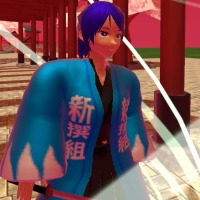
Mitchy Samurai
685 Besuche
Spaces
LesezeichenFind 3 Samurai girls - Drive a car
Drive a car and find 3 Samurai girls hidden in the town. This space uses the noise of Gaussian Splatting not as a flaw, but as a mechanism of concealment. You must enter the cloud to find what cannot be seen. Shinsengumi is a group of Samurai swordsmen in the late 19th century Japan. Reborn in the metaverse. Enjoy driving a carMystical Japanese Forest Shrine
Tranquility of Imaginery Japanese Shrine.Samurai Drama Scene - Shinsengumi Ikedaya Inn
Samurai Drama Scene. Shinsengumi is a group of Samurai swordsmen in the late 19th century Japan and is a special police force in then-capital Kyoto. Shinsengumi raided the Ikedaya Inn to crack down on anti-Shogunate elements. 新撰組池田屋事件時代劇セットのイメージでござるHidden Sacred Cave in Japan
Imaginery spiritual cave inspired by a local legend in Japanese countryside. Looks good from front.Samurai Street Shinsengumi Kyoto 19th Century
Shinsengumi 新撰組 is a group of Samurai swordsmen in the late 19th century Japan. It is a special police force to crack down on Roushi, anti-Shogunate elements, in then-capital Kyoto. Shinsengumi patrolled streets like this. Shinsengumi wears light blue Kimono jacket. Only Kondo Isami, Commander, wears white Jacket. Roushi, enemy of Shinsengumi, wears brown Kimono jacket.Samurai Castle Shinsengumi respect Aizu
Shinsengumi is a group of Samurai swordsmen in the late 19th century Japan, and was a special police force in Kyoto. Shinsengumi was supervised by Lord Aizu. This is a castle of the Aizu clan. I used Fuji's model: "National Historic Site: Tsuruga Castle(japan)" (https://skfb.ly/6QYXz) by Fuji is licensed under Creative Commons Attribution (http://creativecommons.org/licenses/by/4.0/).Dark Lord Castle 第六天魔王信長の城
Oda Nobunaga 織田信長 is Samurai Feudal Lord in the 16th century Japan, during the Warring States Period. Samurai Lords were fighting each other and Nobunaga almost "united" other Lords by his might. Oda Nobunaga was known as the Sixth Heavenly Demon King 第六天魔王. This is a fictional castle of Nobunaga, created based on that image of the Demon King.Metaverse Shinsengumi Mitchy
Shinsengumi is a group of Samurai swordsmen in the late 19th century Japan.The Sacred Cave of Mt.Tateyama Religion, Japan
Mt. Tateyama is one of the 3 sacred mountains in Japan. The ledend says the mountain was opened for people for Buddhist worship. In 701, Saeki Ariyori, son of the govener, hit a bear with an arrow. He followed the bleeding bear deep into the moutain. In the cave, he saw Amitabha Buddha with the arrow stuck in her chest. The bear was the Buddha! Ariyori was manifested to make Mt. Tateyama as a base for spiritural training. Ariyosi is depicted as armored Samurai, but a liitle failed. Looks good from back.Dojo - Samurai Sword Practice Hall
Kenjutsu Dojos in Edo-Period Japan (1603–1868) What they were A dojo (literally "place of the Way") was a training hall dedicated to kenjutsu — the martial art of sword fighting. Think of it as a cross between a martial arts gym and a guild school, where students learned not just technique, but discipline, ethics, and a way of life. Who trained there Students were primarily samurai, Japan's warrior class, for whom swordsmanship was a professional and moral obligation — much like how a medieval European knight was expected to master horsemanship and combat. However, by the later Edo period, wealthy merchants and commoners could also enroll in some schools. How training worked Students progressed through ranked levels under a single sensei (master), who held a license in a specific ryū (school or style — there were hundreds, each with secret techniques). Early training used wooden swords (bokken); advanced students practiced with shinai (bamboo swords) and protective armor (bogu), making sparring safer and more dynamic. A formal mokuroku (certificate of transmission) was awarded at each stage — similar to today's belt system in karate. Their social role Dojos were hubs of samurai culture and networking. Travelling swordsmen (musha shugyō) would visit rival dojos to test their skills — a practice resembling a journeyman craftsman touring workshops across Europe. Their legacy When the samurai class was abolished in the 1870s, kenjutsu dojos evolved into kendō schools, which survive worldwide today as a competitive sport and discipline. In short: imagine a medieval guild hall, a monastic school, and a boxing gym rolled into one — that's the spirit of an Edo-period kenjutsu dojo.Cherry Blossoms in the 18th century Japan
Cherry Blossoms Stereotype Japan Collection by Japanese creatorSmall Warehouse mp4 to Splat test
Generated from Video To Splat processingNinja, Japan
Ninja Stereotype Japan Collection by Japanese creatorCasle Japan
Japanese castle You can teleport from the gate, blue, to the top of the castle tower, red.Community Hearth, wood pellet stove Japan
A decentralized community space centered around shared warmth and resilience. Designed for snowy rural regions where heating is essential for daily life. Using wood pellet or wood stoves powered by local biomass resources. Encouraging people to gather, connect, and support one another. My vision for a more energy-resilient future rooted in local communities.Zen Garden, Japan
Stereotype Japan Collection by Japanese creatorSamurai Battle in 1561 川中島の戦い
The legendary duel at the Fourth Battle of Kawanakajima (1561): Uesugi Kenshin broke through Takeda lines on horseback and struck at Shingen directly with his sword. Shingen, caught off guard without his weapon ready, deflected the blows with his iron war fan (*tessen*). Before Kenshin could finish the attack, a Takeda retainer drove him off with a spear. This dramatic moment is celebrated as one of the most iconic scenes in Japanese history — though whether it actually happened is debated by historians.Sunflower Girl
Sunflower Girl


